


Plant Calculator
Enter the approximate length and width of the area you will be planting and click 'Calculate' to determine how many Dermatophyllum secundiflorum you will need.
*Correct and successful spacing is complex and depends on project conditions.
Mountain Laurel (Mescal Bean)
Dermatophyllum secundiflorum
- Fragrant blooms
- Texas Evergreen native
- Toxic seeds
- Category: Trees & Shrubs
- Hardiness Zone: 7b
- Height: 25-30 Feet
- Spread: 20-25 Feet
- Spacing: 8-12 ft
- Bloom Color: Blue, Purple
| Item | Size | Avail | Your Price | Qty |
|---|---|---|---|---|
| MTN-LAU-01 | #001 | Out of Stock | Login for Pricing | |
| MTN-LAU-05 | #005 | Low Stock | Login for Pricing | |
| MTN-LAU-15 | #015 | In Stock | Login for Pricing | |
| MTN-LAU-30 | #030 | In Stock | Login for Pricing | |
| MTN-LAU-24B | 24BOX | In Stock | Login for Pricing | |
| MTN-LAU-95 | 32BOX | Low Stock | Login for Pricing | |
MTN-LAU-01
MTN-LAU-05
View Current CropMTN-LAU-15
View Current CropMTN-LAU-30
View Current CropMTN-LAU-24B
View Current CropMTN-LAU-95
View Current Crop
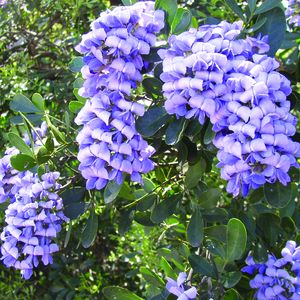
Texas Mountain Laurel is a slow-growing, evergreen shrub or small tree native to Central, South, and West Texas, commonly found growing in rocky limestone soils of the Hill Country. It is prized for its glossy dark green foliage and its highly fragrant purple flower clusters that bloom in early spring, often compared to the scent of grape soda. Bloom color ranges from deep violet to bluish-purple, and mature plants can become spectacular focal points in the landscape. Although rare, white blooming cultivars exist.
This plant thrives in full sun and is exceptionally well adapted to alkaline, rocky, well-drained soils. Once established, it is highly drought tolerant and performs best with minimal irrigation. It does not tolerate poorly drained soils. Mature size typically reaches 10–20 feet tall and 8–15 feet wide, though it grows slowly. Space 8–12 feet apart when planting in groups. All parts of the plant — particularly the bright red seeds — are poisonous if ingested. However, the seeds are encased in an extremely hard outer shell. These shells are very tough, resist decay, and can persist on the ground for years, which reduces accidental exposure but means fallen seeds may remain visible long after drop. The plant is generally deer resistant.
Texas Mountain Laurel works beautifully as a specimen tree, courtyard accent, entry focal point, or evergreen screen in Hill Country and Central Texas landscapes. Its dense structure and dark foliage provide year-round presence, while its spring bloom season delivers one of the most dramatic floral displays of any Texas native shrub.
Botanical Name History
For many years, this plant was classified as Sophora secundiflora, which is still widely used in the nursery trade, older literature, and landscape specifications. However, botanical research and genetic studies determined that this North American species was sufficiently distinct from the true Asian Sophora species. As a result, it was reclassified into the genus Dermatophyllum, becoming Dermatophyllum secundiflorum.
Because the name change is relatively recent in horticultural terms, both botanical names are still commonly encountered.
Critter Resistance
| • | Deer Resistant |
Poor Drainage Tolerant
| • | No |
Habit
| • | Evergreen |
Soil pH Preference
| • | Alkaline |
Texas Native
| • | Texas Native |
Deer Tolerance
| • | High |
Water Needs
| • | Low |
Toxic to Pets
| • | Seeds |
Texas SuperStar Plants
| • | Yes |
Additional Information about Dermatophyllum secundiflorum
Previously known as Sophora secundiflorum
Growing & Maintenance Tips for Dermatophyllum secundiflorum
Orange to red seeds are thought to be extremely poisonous, but its actually the cotyledon (the white part inside the very tough shell) that's lethal.