

Plant Calculator
Enter the approximate length and width of the area you will be planting and click 'Calculate' to determine how many Dietes bicolor you will need.
*Correct and successful spacing is complex and depends on project conditions.
Dietes bicolor
Iris, Bicolor
- Perennial Color
- Perennial Borders
- Heat Hardy
- Category: Seasonal, Tropical, and Perennial Color
- Hardiness Zone: 8a
- Height: 3-4 Feet
- Spread: 3 Feet
- Spacing: 3 ft
- Bloom Color: Yellow
Bicolor Iris (Dietes bicolor), sometimes still seen under its older botanical name Morea bicolor, is an evergreen, clump-forming perennial native to southern Africa. In Central Texas it behaves as a reliable, long-lived landscape plant rather than a true iris, offering structure year-round with intermittent blooms from spring through fall. Its upright, sword-like foliage gives a clean, architectural look even when the plant is not in flower.
In the Texas landscape, Bicolor Iris is valued for its toughness and adaptability. It performs well across much of Central and South Texas, tolerating heat, humidity, and a wide range of soils, including alkaline conditions. While it prefers well-drained soil, it is more forgiving of occasional poor drainage than many ornamentals once established. Full sun produces the best flowering, but it also performs well in part sun, especially with some afternoon shade in hotter inland locations.
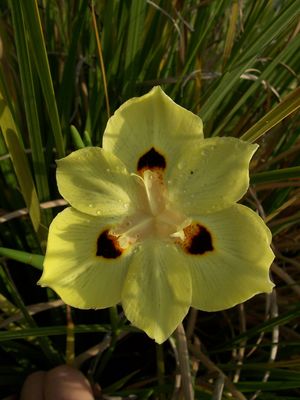
Plants typically reach 3 to 4 feet tall and about 3 feet wide, forming dense clumps over time. When planted in groups, spacing of 3 feet apart allows plants to fill in without crowding. The pale yellow flowers, marked with darker contrasting signals, are short-lived individually but appear repeatedly over a long season. Bicolor Iris is commonly used as a mass planting, along walkways, as a low screen, or as a strong vertical accent in mixed borders.
Bicolor Iris is considered non-toxic except for the rhizomes (roots), and is generally deer-tolerant, making it a dependable choice for commercial and residential landscapes alike. It is low-maintenance once established, requiring only occasional cleanup of old foliage and spent flower stalks. During severe freezes, foliage may burn back, but plants reliably regrow from the base in spring with no special winter protection required.