


Plant Calculator
Enter the approximate length and width of the area you will be planting and click 'Calculate' to determine how many Quercus polymorpha you will need.
*Correct and successful spacing is complex and depends on project conditions.
Oak, Mexican (Polymorpha) (Oak, Polymorpha)
Quercus polymorpha
- Fast Growing, Long Living
- Low Maintenance
- Texas Superstar
- Category: Trees & Shrubs
- Hardiness Zone: 7b
- Height: 40-80 Feet
- Spread: 25-50 Feet
| Item | Size | Avail | Your Price | Qty |
|---|---|---|---|---|
| OAK-MEX-01 | #001 | In Stock | Login for Pricing | |
| OAK-MEX-05 | #005 | In Stock | Login for Pricing | |
| OAK-MEX-15 | #015 | In Stock | Login for Pricing | |
| OAK-MEX-30 | #030 | Low Stock | Login for Pricing | |
| OAK-MEX-45 | #045 | Low Stock | Login for Pricing | |
| OAK-MEX-95 | #095 | Low Stock | Login for Pricing | |
| OAK-MEX-125 | 36BOX | Low Stock | Login for Pricing | |
| OAK-MEX-200 | #200 | Low Stock | Login for Pricing | |
| OAK-MEX-300 | #300 | Out of Stock | Login for Pricing | |
OAK-MEX-01
View Current CropOAK-MEX-05
View Current CropOAK-MEX-15
View Current CropOAK-MEX-30
View Current CropOAK-MEX-45
View Current CropOAK-MEX-95
View Current CropOAK-MEX-125
View Current CropOAK-MEX-200
View Current CropOAK-MEX-300
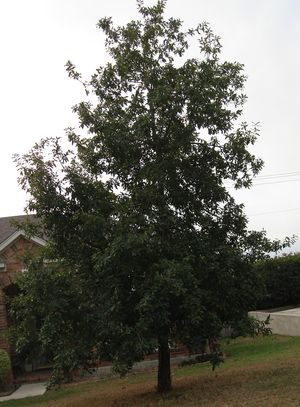
The Mexican Oak, also known as Monterrey Oak, is a versatile and resilient tree well-suited for Texas landscapes. This semi-evergreen species is known for retaining much of its foliage through winter, typically dropping 50-75% of its leaves in early spring just before new growth emerges. This results in many concerned homeowners that think something may be wrong with the tree, however we like to consider the Mexican Oak the “burlesque dancer” of the oak family – graceful, unique, and a little unconventional in its timing. The leaves themselves can be unconventional in a sense, as they vary from tree to tree. This is one reason the scientific name is “polymorpha”. The texture is always the same, but shape and lobe depth varies tree to tree.
While a mature height of 80 feet is possible, it will average 60 feet in a normal landscape. It serves as an excellent shade tree for large properties, parks, or open spaces. As a member of the white oak group, the Mexican Oak is highly resistant to Oak Wilt, a devastating disease that affects many other oak species in Texas. This resistance makes it an excellent choice for areas where Oak Wilt is a concern. Its adaptability to various soil types, including rocky or alkaline soils, and its tolerance to heat and drought make it particularly well-suited for Texas's challenging climate conditions. The tree thrives in full sun and requires minimal maintenance once established, making it a favorite among landscapers and homeowners alike.
The Mexican Oak is not only functional but also aesthetically appealing, with a dense, rounded canopy that provides excellent shade. Its semi-evergreen nature ensures year-round visual interest, while its sturdy growth habit makes it highly durable against wind and storms. Whether used as a specimen tree or in group plantings, the Mexican Oak offers a combination of beauty, disease resistance, and environmental adaptability, making it a standout choice for Texas landscapes.
Oak Wilt Awareness:
Oak wilt is a serious concern in Central Texas. All oaks can be affected, though susceptibility varies by species. To reduce risk, avoid planting new oaks close to existing mature oaks where root systems may eventually connect. Never prune oaks during high-risk periods (generally February through June), as fresh cuts attract sap beetles that spread the disease. Many Texas municipalities enforce seasonal oak pruning restrictions, and in some areas pruning oaks during certain months is prohibited by ordinance. Always seal any necessary pruning cuts immediately with paint to help prevent infection.
Oak Wilt Groups :
Red Oak Group - Most susceptible; often fatal quickly
Live Oaks - Highly susceptible; spreads aggressively through root grafts
White Oak Group - More resistant; typically least severe
Mexican Oak (Quercus polymorpha) belongs to the White Oak group
Critter Resistance
| • | Deer Resistant |
Exposure
| • | Full Sun |
Habit
| • | Evergreen |
Soil pH Preference
| • | Alkaline |
Texas Native
| • | Texas Native |
Deer Tolerance
| • | High |
Water Needs
| • | Low |
Texas SuperStar Plants
| • | Yes |