


Plant Calculator
Enter the approximate length and width of the area you will be planting and click 'Calculate' to determine how many Vitex agnus-castus you will need.
*Correct and successful spacing is complex and depends on project conditions.
Vitex, Chaste Tree
Vitex agnus-castus
- Warm season bloomer
- Drought tolerant
- Pollinator friendly
- Category: Trees & Shrubs
- Hardiness Zone: 6b
- Height: 15-25 Feet
- Spread: 15-25 Feet
- Spacing: 12-15 feet
- Bloom Color: Blue, Purple
| Item | Size | Avail | Your Price | Qty |
|---|---|---|---|---|
| VITX-05 | #005 | In Stock | Login for Pricing | |
| VITX-15 | #015 | In Stock | Login for Pricing | |
| VITX-30 | #030 | In Stock | Login for Pricing | |

VITX-05
View Current CropVITX-15
View Current CropVITX-30
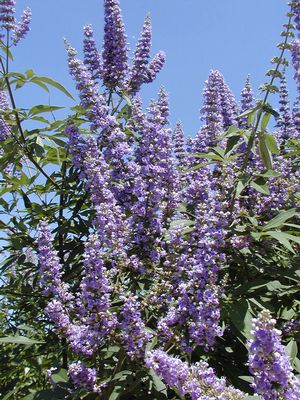
View Current CropVitex or Chaste Tree, is a deciduous large shrub or small tree widely used across Texas for its heat tolerance and long summer bloom season. Though not a Texas native, it has proven exceptionally well adapted to Texas conditions and is especially valued for providing color during the hottest months when many other plants stop flowering. Its airy structure and aromatic foliage give it a light, informal appearance in the landscape.
Vitex thrives in full sun and performs best in well-drained soils, including the alkaline soils common throughout much of Texas. It is highly drought tolerant once established and does not tolerate consistently wet or poorly drained sites. Afternoon heat is not an issue for this plant; in fact, strong sun encourages better flowering and sturdier growth. It is well suited for Central, South, and much of North Texas.
This plant is commonly used as a small shade tree, multi-trunk specimen, or large screening shrub. Mature size typically ranges from 15–25 feet tall and wide, depending on pruning and growing conditions. Vitex blooms from late spring through summer, producing showy spikes of lavender to purple flowers that are highly attractive to bees and other pollinators. It is considered deer tolerant and is generally regarded as non-toxic in the landscape.
Vitex is very forgiving when it comes to winter care and pruning. It can be left to grow naturally or cut back hard in late winter to maintain a more compact, shrub-like form and encourage vigorous new growth and flowering. It is fully cold hardy through most of Texas, and winter dieback, if it occurs, is usually followed by strong regrowth in spring.
This plant is commonly used as a small shade tree, multi-trunk specimen, or large screening shrub. Mature size typically ranges from 15–25 feet tall and wide, depending on pruning and growing conditions. Vitex blooms from late spring through summer, producing showy spikes of lavender to purple flowers that are highly attractive to bees and other pollinators. It is considered deer tolerant and is generally regarded as non-toxic in the landscape.
Vitex is very forgiving when it comes to winter care and pruning. It can be left to grow naturally or cut back hard in late winter to maintain a more compact, shrub-like form and encourage vigorous new growth and flowering. It is fully cold hardy through most of Texas, and winter dieback, if it occurs, is usually followed by strong regrowth in spring.